Updated August 2026
How to start a bounce house business (2026): the complete playbook
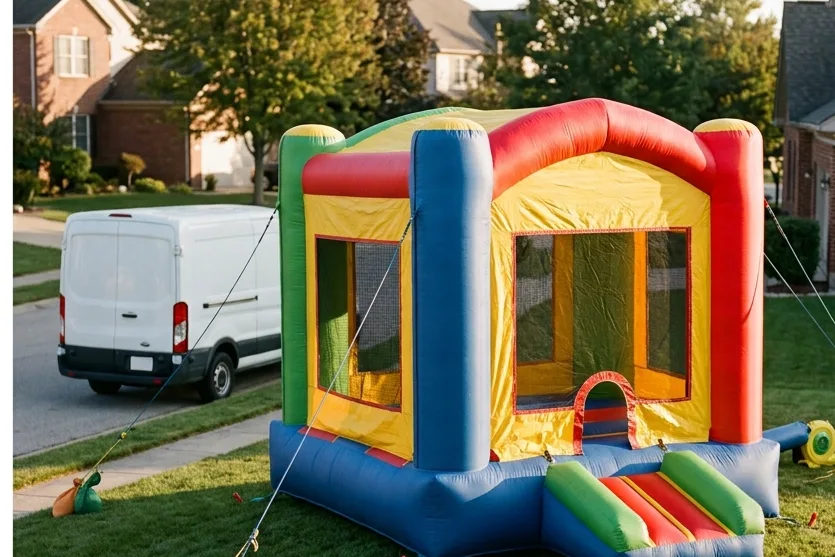
A bounce house rental business is one of the few real businesses you can start out of a garage, run off your phone, and grow one unit at a time. The work is physical — you are loading, driving, anchoring, and cleaning — but the model is simple: buy a commercial inflatable, rent it out on weekends, and let it pay itself off over a season or two.
This is the whole path, in the order you will actually hit it: what it costs, whether the money is real, what to buy, how to stay legal and insured, how to price, how to run the day, how to get your first customers, and how to survive a business that mostly earns for seven or eight months a year. No “passive income” promises, no fluff — just the playbook a working operator wishes someone had handed them, with two calculators and a launch checklist you can use whether or not you ever sign up for anything.
What you are actually signing up for
Before the spreadsheets, be honest about the shape of the work. Roughly 90% of rentals land on weekends, and most of your revenue arrives between spring and early fall. On delivery day you are a delivery driver and a setup crew. The “business owner” part — quoting, marketing, tracking which units earn — happens in the margins during the week.
That is not a warning meant to scare you off. It is the thing to design around. The operators who last treat the weekday admin as the real job and the Saturday hustle as the product. Get the boring parts right — insurance, contracts, a booking system that never double-books — and the business runs. Skip them and one bad weekend can end it.
The good news: the barrier to entry is low, the demand is steady and local, and you can start part-time with a single unit and prove the market before you spend real money. Let’s walk it.
Is a bounce house business worth starting?
For a lot of people, yes — with clear eyes. Margins are healthy once your gear is paid off: operators commonly run a 20–40% net profit margin, and 30–40% shows up on well-run six-figure operations (per Happy Jump and JumpOrange). A single commercial unit that books most in-season weekends often pays for itself within a season or two.
But profitability lives in utilization, not in the sticker price you charge. A unit that books eight weekends earns; the same unit booking three does not. Everything in this playbook — what to buy, how to price, how to get reviews, how to never double-book — is really about keeping each unit working. Two chapters go deep on the numbers: profit margins, with a per-unit ROI calculator, and startup costs, with a calculator that totals your cash-to-launch.
If you want to know before you spend anything, put those two chapters’ numbers into a plan. You do not need a formal document to take your first booking, but you do need one the moment a bank, a leasing company, or a co-signer has to evaluate you — and writing the revenue projection is what forces you to answer honestly how many weekends each unit will really book. How to write a bounce house business plan walks the one-page version, the sections a lender reads, and how to build a projection from utilization rather than a wish.
Step 1 — Know what it really costs
You can start leaner than most courses tell you, but not for nothing. A lean one-unit start runs roughly $2,500–$4,000 all-in including a year of insurance. Add a trailer and a fuller lineup and industry breakdowns put a typical micro start (1–2 units) at about $10,000–$18,000, with fully built-out operations running anywhere from $10,000 to $50,000 (per JumpOrange and Hero Kiddo 2025–2026 breakdowns).
The one-time line items are the units, the gear each unit needs (a blower, stakes or ballast, a tarp, cords), and optionally a trailer. The recurring ones are insurance, fuel and vehicle wear, cleaning and repair supplies, and any local license or sales tax. The single figure that surprises new operators most is insurance, so budget for it from day one.
The full line-by-line breakdown, two honest budgets, and a calculator that adds up your exact plan are in what it costs to start.
Step 2 — Buy the right units, in the right order
The most expensive early mistake is buying the wrong gear. Rentals demand commercial-grade inflatables — heavier reinforced vinyl, commercial stitching and blowers, built for daily setup and teardown. Residential (backyard) units are made for occasional family use; rent one out and it wears out fast and can void your insurance and any safety claim. New commercial units run roughly $1,500 to $8,000 depending on size and features (per Jump Centers 2025).
Start narrow. A bounce-and-slide combo is the strongest first buy for most operators — it rents for more than a plain bouncer and books more often because it fills more of a party. A practical buying order is a combo first, a classic castle or themed bouncer second, a water slide third for summer demand, then tables, chairs, and tents as sticky add-ons. Then let your own bookings reorder the list. The full breakdown of commercial vs residential and what to buy first is in your first inflatables.
Step 3 — Set up the business itself
Keep this lightweight, but do not skip it:
- Register the business. Most operators form an LLC for the liability separation between the business and their personal assets — meaningful in a trade where someone can get hurt. State filing fees run about $35 to $500, most between $50 and $200 (per LLC University 2025–2026).
- Get an EIN. It is free directly from the IRS at irs.gov and issued immediately, so your personal Social Security number stays off contracts and tax forms. Never pay a third-party site for one.
- Open a separate bank account. Even one dedicated account makes taxes and per-unit profit tracking dramatically easier.
- Check local rules. Many cities require a business license and sales-tax collection, and a number of states regulate inflatable amusement devices directly — inspections, operator permits, or minimum ride-insurance limits. There is no single national rule; look up your own state and city before your first paid setup.
None of this is legal advice — it is the standard footwork. The full walkthrough is in bounce house business license, LLC, and permits, which also shows what a state inflatable-device rule actually looks like in four states that publish one, and how to find the office that governs you in your own.
Step 4 — Get insured (the one you never skip)
Insurance is the difference between a bad Saturday and a business-ending one. The core coverage is commercial general liability, and many venues will not let you set up without proof of it.
Premiums vary, but commercial general liability for a small operation commonly runs about $1,800–$2,500 per year, with an overall average around $140 per month once you add other coverages (per MoneyGeek and JumpOrange 2026 rates). Get quotes from carriers and brokers who specialize in inflatable and amusement rentals — general small-business insurers often will not write the risk, and a specialist prices it correctly.
Two things to nail down up front: whether your policy can quickly issue additional-insured certificates (schools, churches, parks, and cities routinely require one naming them before you set up), and what raises or lowers your premium over time — a clean claims history commonly earns a 5–10% discount, while a single severe claim can raise it sharply. Full detail in bounce house business insurance.
Step 5 — Price so the math works
Your price has to cover more than the unit rental — it has to cover the drive, the setup labor, the wear, and the days the unit sits idle. Most operators price per unit per day, add a delivery fee by distance, and bump weekend and peak-season rates.
Typical US day rates run about $150–$250 for a basic bouncer, $200–$500 for combos, and $300–$550 for water slides (per JumpOrange and Thumbtack surveys), but regional variation is large and your local market sets the ceiling. Do not copy a number — copy the method: price up from your costs and delivery radius, not down from a competitor. The full cost-up method is in pricing your rentals.
Step 6 — Nail safety before your first setup
Safety is both the right thing and your best insurance argument. The non-negotiables, framed the honest way — always defer to your specific unit’s manual and your local rules over anything you read here:
- Anchor every unit fully. Use every anchor point the manufacturer marks; partial anchoring provides no protection. On grass, the ASTM F2374 standard references stakes of at least 1 inch by 18 inches, with each anchor point resisting about 1,600 N (360 lbf); on hard surfaces, ballast of at least roughly 80 lbs per anchor point (per ASTM F2374 and JumpOrange).
- Respect the wind. ASTM F2374 sets a default maximum of 15 mph sustained wind for operation, and research found most wind incidents happened below the 25 mph design threshold — which is why 15 mph is the common shutdown point. Check your unit’s manual for its exact number and watch the forecast.
- Supervise, always. An adult attendant, rider limits by age and size, no shoes, no flips, no piling on.
- Write it down. Photograph the anchors, blower, and clearances at each setup with a timestamp. That record protects you if anyone ever asks what happened.
The full safety walkthrough, plus where operator training like SIOTO fits, is in safety and certification.
Step 7 — Put contracts and deposits in front of every booking
Three documents turn a handshake into a real booking: the rental contract (the terms of the deal), the deposit (which holds the date and signals a serious customer), and the liability waiver (the customer acknowledging the risks and their supervision responsibility). Together they prevent the driveway argument and protect you when something goes wrong.
You do not need a lawyer to draft — you need a lawyer to review the templates you will reuse on every booking, because release and waiver enforceability varies by state. The contracts and waivers chapter includes a free build-your-own checklist of every clause each document should cover.
Step 8 — Take bookings without double-booking yourself
Here is where new operators quietly lose money: bookings live in Facebook messages, a paper calendar, and their memory. Then two customers book the same unit for the same Saturday, and you are renting from a competitor at cost to save the date — or eating a one-star review in a business where reviews are everything.
From your very first booking, run a system that does four things: checks the unit is actually free before you confirm a date, sends a real quote and a signed contract with your waiver and weather policy inside it, collects a deposit to hold the date, and keeps the whole thing on your phone, because you are never at a desk when the calls come in.
That is the loop BounceDay was built for — photograph your fleet, then on Solo and up send a signed and deposited booking from the truck and walk into the weekend with your stops in order. The free tier gives you your own storefront and handles 5 bookings a month, enough to run your first weekends, and your client can pay the deposit by card or bank transfer straight into your own account. Where the bookings themselves come from is its own chapter: getting your first 10 customers.
Step 9 — Run the day, then survive the off-season
Two operational realities separate people who last from people who burn out. The first is the day itself — a full Saturday of stops runs on a route, a loading order, and a repeatable setup routine, all covered in delivery, setup, and running a Saturday of stops. The second is the calendar: this is a brutally seasonal business, and the operators who make it plan their cash flow around a spring-to-fall season and earn through the quiet months. How to do that — indoor bookings, pre-selling spring, and timing your unit purchases for the off-season — is in seasonality and cash flow.
Step 10 — Grow only where growth adds profit
Once the calendar fills, the temptation is to buy everything and hire fast. Resist it. Add capacity to meet demand you have already proven, reinvest in the specific units that book most and earn most per dollar, and systemize your booking, contracts, and day-of run before you scale — because the booking system is what breaks first when two crews share a fleet. When and how to grow past a one-truck operation is in scaling past solo.
A realistic first-season timeline
- Weeks 1–4: register, insure, buy one or two commercial units, photograph and list them, set your prices, and write your contract and rain policy.
- Weeks 5–8: launch a simple page, post in local community groups, and tell everyone you know. Take your first bookings with deposits.
- The season: deliver, document every setup, collect reviews relentlessly, and track which unit earns the most.
- The off-season: clean, repair, review your per-unit numbers, and buy your next unit for spring.
One documented solo operator launched with about $12,500, two bounce houses and a combo, and did roughly $28,000 in first-year revenue at about a 28% net margin (per JumpOrange). Treat any single figure as a data point, not a promise — your market, your weekends worked, and your utilization set the real number.
Start small, get the safety and the booking system right, and let the reviews and repeat customers compound. That is the whole business. Work through the chapters below in order, or jump to what you need next. If you only remember four rules before your first delivery, keep the first-unit playbook next to your calendar.
The rest of the library
The playbook is the spine. Four other collections sit beside it, and each one answers a question this page can only point at.
- Bounce house rules by state. Whether inflatables are regulated where you work, which agency has jurisdiction, and what a permit, an inspection, or an insurance minimum actually costs you. All 50 states and the District of Columbia, sourced from statutes and agency pages, with the gaps in the research marked as gaps.
- Free operator templates. The six documents a rental operation runs on: the contract, the participant waiver, the pre-use inspection checklist, the weather policy, the invoice, and the certificate request you send your agent. All on the page, no email wall.
- Free calculators. The startup-cost and rental-ROI calculators on their own pages, so you can come back to either one without hunting for the chapter it lives in.
- Operator guides. The pieces that are not part of a launch sequence: anchoring and wind limits, writing a rain policy, the certificate of insurance a venue asks for, which categories earn, and when to retire a unit.
Get this as a 7-day course
One short email a day, the whole start-to-first-job path, written for someone doing this for the first time. Unsubscribe with one tap, any time.
You're in. Day one lands within a day. Check the promotions tab if it hides.
That didn't send. Check the address and try once more.
The chapters, in order
Read it start to finish, or jump to what you need. Every chapter stands on its own and ends with straight answers to the questions operators actually ask.
- Chapter 1What it costs to start a bounce house businessThe real line items behind a bounce house startup — units, gear, a trailer, insurance, and registration — with two honest budgets and a calculator that totals your cash-to-launch.Read it →
- Chapter 2Bounce house rental profit margins, honestlyWhat a bounce house business actually earns — realistic net margins, why utilization beats sticker price, and a per-unit ROI calculator that shows payback months and first-year profit.Read it →
- Chapter 3How to write a bounce house business planA bounce house business plan you will actually use — the one-page version first, then the sections a lender reads, an honest utilization-based revenue projection, and the mistakes that make a plan worthless.Read it →
- Chapter 4Your first inflatables: commercial vs residential, and what to buyWhy commercial-grade is non-negotiable for rentals, the difference between residential and commercial vinyl, and a buying order for your first units chosen by how often each books.Read it →
- Chapter 5Bounce house rental business insurance, from scratchWhat bounce house rental insurance covers, what it typically costs, why you need a specialist carrier, and the additional-insured certificate that gets you into schools, churches, and parks.Read it →
- Chapter 6Bounce house business license, LLC, and permitsDo you need a business license to rent out bounce houses? What a license actually covers, LLC vs sole proprietor, the free EIN, sales tax on rentals, and the state inflatable-device rules that catch new operators off guard — with the agency to ask in your own state.Read it →
- Chapter 7Pricing your bounce house rentals so the math worksA cost-up pricing method for bounce house rentals — covering the drive, setup, wear, and idle days — plus typical US rate ranges, delivery fees, and weekend and seasonal surcharges.Read it →
- Chapter 8Delivery, setup, and running a Saturday of stopsHow to run a full day of bounce house deliveries — planning the route, loading the truck, a repeatable anchoring and setup routine, and the photo-stamped record that protects you.Read it →
- Chapter 9Getting your first 10 bounce house customersWhere the first bookings actually come from — your own network, local Facebook groups, a simple listing, reviews, and the referral habits that turn one weekend into a booked calendar.Read it →
- Chapter 10Seasonality and cash flow in a bounce house businessA bounce house business is brutally seasonal — how to plan for a spring-to-fall season, survive the winter trough, earn in the off-season, and time your unit purchases.Read it →
- Chapter 11Safety and certification for bounce house operatorsThe safety non-negotiables — anchoring, wind limits, and supervision — the ASTM standard behind them, and where operator training like SIOTO fits. Always defer to your unit manual and local rules.Read it →
- Chapter 12Contracts and waivers for bounce house rentalsThe documents that turn a handshake into a real booking — the rental contract, the deposit, and the liability waiver — what each does, what belongs in it, and a free checklist to build your own.Read it →
- Chapter 13Scaling a bounce house business past soloWhen and how to grow beyond a one-truck operation — reinvesting in the units that earn, adding help and a second vehicle, systemizing bookings, and knowing which growth actually adds profit.Read it →
Free toolkit
The bounce house launch checklist
Every step from decision to your first paid Saturday, in order — buy, insure, register, price, and take your first booking without missing a beat.
Something went wrong. Please try again in a moment.
Set up the business
- Decide what you'll rent first — usually one versatile commercial combo unit.
- Register the business (most operators form an LLC) and check your state's fee.
- Get a free EIN from the IRS so your Social Security number stays off contracts.
- Open a separate business bank account for clean books and per-unit tracking.
- Check your city, county, and state for a business license, sales tax, and inflatable-device rules.
Buy and insure
- Buy commercial-grade units only — never backyard/residential vinyl for rentals.
- Get quotes from insurers who specialize in inflatable and amusement rentals.
- Confirm your policy can issue additional-insured certificates for schools, churches, and parks.
- Buy the gear each unit needs: blower, correct stakes or ballast, tarp, cords, mallet.
Get ready to book
- Set prices from your costs and delivery radius up — not from a competitor down.
- Write your rental contract, liability waiver, and rain and cancellation policy.
- Photograph and list your units, and set up a way to take a request, quote, and deposit.
- Make sure you can check a unit is free before confirming a date — never double-book.
Launch
- Tell your own network and post in local community and parent groups.
- Take your first bookings with a signed contract and a deposit.
- Document every setup with dated photos of the anchors, blower, and clearances.
- Ask every happy customer for a review the day after the event.
A starting point to adapt — verify every legal and insurance step for your own state.
Frequently Asked Questions
How much does it cost to start a bounce house business?
A lean one-unit start runs roughly $2,500–$4,000 all-in including a year of insurance; industry breakdowns put a typical micro start (1–2 units) at about $10,000–$18,000 once you add a trailer and a fuller lineup, and a fully built-out operation anywhere from $10,000 to $50,000 (per JumpOrange and Hero Kiddo 2025–2026 startup breakdowns). Buy commercial-grade units, not backyard ones. The startup-cost calculator in the costs chapter adds it up for your exact plan.
Is a bounce house rental business profitable?
It can be. Operators commonly run a 20–40% net margin, with 30–40% cited on well-run six-figure operations (per Happy Jump and JumpOrange). A single commercial unit renting most weekends in season often pays for itself within a season or two. Profit lives in utilization — how many weekends each unit actually books — not in the sticker price you charge.
Do I need a license or an LLC to rent bounce houses?
It depends entirely on your state and city — there is no single national rule. Most operators register as an LLC for liability separation (state filing fees run about $35 to $500, most $50–$200, per LLC University 2025–2026) and get a free EIN from the IRS. Many localities also require a business license and sales-tax collection, and a number of states regulate inflatable amusement devices directly. Look up your own state and city before your first paid setup.
How many bounce houses do I need to start?
One good commercial unit is enough to take real bookings; two or three lets you cover a fuller weekend and offer choices. Start with what you can deliver and set up alone, and let your bookings tell you what to buy next.
Can I run a bounce house business part-time?
Yes — most operators start exactly this way. Roughly 90% of rentals land on weekends, so a one-truck operator can run it around a weekday job. The weekday admin (quoting, insurance, tracking which units earn) is the real business; the weekend hustle is the product.
When you're ready to take your first booking
BounceDay is built for solo and small-crew bounce house operators — photograph your fleet, send signed and deposited bookings from your phone on Solo and up, and never double-book a unit. The free tier handles 5 bookings a month and gives you your own storefront, so you can take card and bank deposits before you pay us anything.
Start free